Showing posts with label Artifacts. Show all posts

16 August 2014

Whitehawk Hill Excavations

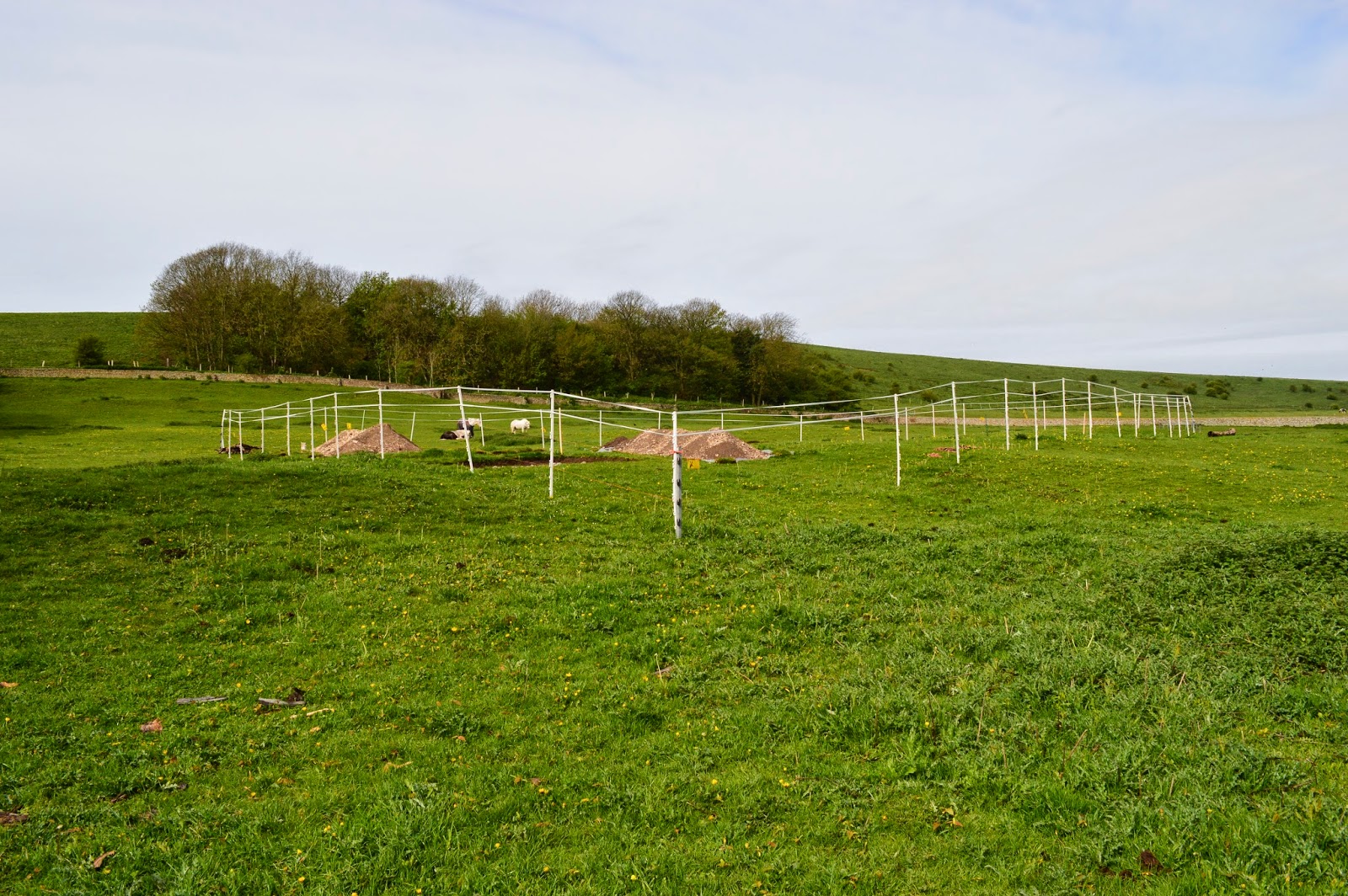
I was not planning on joining this new Brighton dig that began last week (only for the month of August) but curiously, I found myself out there two days ago on my day off. And I'm glad I went. The view of Brighton and the sea is absolutely stunning from this site. The day started off with a glorious blue sky only to abruptly change to storm clouds by mid afternoon. The storm hit just as I got home to Lewes around 16:30, so we were quite lucky to get in an entire day of excavations unscathed by inclement weather.

There were plenty of volunteers from the BHAS and professionals from Archaeology South-East as well as a few newcomers. The newcomers including myself were given an induction to the site. From what we were told this site dates back to the Neolithic (different from the Neolithic period anywhere else in Europe since it started later around 4500 B.C.E. - 2500 B.C.E.) when a new wave of European immigrants brought farming technology to this island and settled in communities, most likely greatly impacting the status quo of the indigenous people as hunter-gatherers.

A reconstruction by Ian Dennis of the
Whitehawk causewayed enclosurec. 3,600 cal BC
(reproduced from Whittle, Healy and Bayliss
2011; fig. 1.3)
Whitehawk hill is an ancient habitat designated as a Local Nature Reserve (LNR) and is recognized as being the first Scheduled Ancient Monument (SAM) in Sussex (Brighton-Hove.gov.uk). The ancient monument, Whitehawk Camp, is one of Britain’s earliest stone age monuments.  The hill was chosen some 5,500 years ago as the site for a series of circular ditches and banks which marked the hill as an area for feasting, burials and other activities of a ritual nature. This curious and obviously non-defensive arrangement gives these sites their name: causewayed enclosures.  They represent the earliest ritual circles in northern Europe and predate later stone age enclosures like Stonehenge and Avebury by up to 1000 years.  They all appear to have been built around 3500 B.C., predating Stonehenge by about 500 years.

Archaeologists have explored only a small portion of Whitehawk Camp.  Within the fill of the surviving ditches the remains of four complete burials have been found alongside huge numbers of stone age flint tools, pieces of pottery and the bones of ox, cattle, pig, deer and other fragmentary human remains.  These suggest the consumption of large amounts of meat as part of the activities which took place on the hill.  The site was important enough to become the final resting place of members of the local tribes and these included the bodies of an eight year old child and a young woman buried alongside the remains of her new born child.  The details of Stone-age religion are largely unknown, but the archaeology suggest an emphasis on seasonal gatherings, the importance of the ancestors, tracking of the seasons through astronomical observation and the marking of territorial ownership. (http://www.brighton-hove.gov.uk/content/leisure-and-libraries/parks-and-green-spaces/whitehawk-camp)

BHAS members, ASE archaeologists, and volunteers.
Our focus was to get down to the Neolithic layers in the trenches and continue what the excavations in the 1920s and 1930s had uncovered, even though a majority of debris was modern. On this particular hill, allotments were established during WWII and after. These are now gone, but remnants still exist in the plethora of broken glass everywhere, modern porcelain, nails, and bits of plastic.

The main trench just had it's turf removed this week, so we were each given slots to trowel back. I discovered no features amidst the chalky and flint infested top soil and the annoying roots that kept interfering with the troweling. Unlike Ovingdean, where the soil is also very chalky, there were finds aplenty. Besides the usual piece of broken glass, I filled my tray with two and a half rusty nails, blue and white decorated porcelain fragments, two or so bits of CBM, charcoal bits, possible pottery fragments but methinks I just filled my finds tray with some sort of stone that looked like IA pottery, possible slag chunks, fire-cracked flint, fragments of oyster shell, snail shells which I chucked out later, two small echinoids (Cretaceous fossils - 145-66 million years ago) and small bone fragments. Not bad in a day's work.

Hope to get up there at least one day a week until the project is finished at the end of August.


7 August 2014

Last of the Plumpton Roman Villa

I happened to have a day off from work last week and debated over checking up on Ovingdean, the Culver Project and Plumpton Roman Villa. I found myself staring at the fine trenches of the villa and the site ditch once again. They have uncovered quite a bit in the past three weeks since I was last up there.

Embarrassingly I forgot my camera so I only have one measly photograph of my find but the crops that I definitely thought were leeks a few weeks ago have transformed into corn. A bit like when Jesus turned water into wine. This turned out to be beneficial to me because the large corn stalks provided much needed shade while I was excavating in Trench 3.

Cow Skull, date unknown at this point.
When I first arrived, I was placed back in Trench 1 with the American student Megan whom I had met a couple weeks ago. We worked on the edge of the ditch, attempting to determine the natural. Plough damage sure made it hard to discern. After a bit, the new supervisor whose name I have now forgotten (sorry!) asked me if I had done this sort of thing before (lots of head nodding and fake smiling) and I found myself relocated to Trench 3 to remove a cow skull that was partially excavated in the lovely hard baked clay. I spent a couple hours there with Andrew (?) a college student who had never done any archaeology before and we made a plan of action to sort of chisel our way underneath the skull in order to prise it neatly from the ground. It did work, surprisingly, because I was able to extract it myself and place it into a tray of bubble wrap. Then, as it was transferred to another tray, it began to crumble. At least our extraction method was successful.

A Twitterer on Twitter commented on my photo and suggested that perhaps it was the Plumpton Poisoner until I pointed out that this skull was indeed a cow and not a human. Although we cannot rule out the cow as the one responsible for adding strychnine to somebody's tea back in the 1935.

Till next time folks! I will likely have a new update on Ovingdean next time!

23 July 2014

Plumpton Roman Villa

Main Trench where the villa is thought to be situated.
Much overdue, but during my week of annual leave I was also able to spend two days on the Sussex School of Archaeology (SSA) summer project out in Plumpton, East Sussex. What a gorgeous site, tucked away behind the college in a field of corn (they looked like leeks). The site itself has been known about for quite some time (circa the past 30 years) through extensive field-walking and geophysical survey. There is thought to be a Roman villa with a hypocaust system (heated flooring), bathhouse,  a ditched enclosure and field system. The date, however is still unknown. Hence the need for an archaeological investigation!

Lizzie and Megan washing finds.

Ditched Enclosure.
 We began by attempting to find the edge to the ditch. Not as easy as it sounds. There is extensive plough damage and the soil was quite confusing to read as it kept appearing as if there were other features next to the ditch.

Some bits and bobs were recovered - pottery, teeth, a nice bone specimen.

Sadly I  have not been able to return to the site for the past week and a half so I am intrigued if any questions have been answered or, as archaeology tends to go, if a plethora of even more questions has arisen!

Another ditched enclosure? Pete is surveying the trench.

11 July 2014

Culver Project AKA Bridge Farm

Bridge Farm  was one of those digs that I tried to make it to last summer, but as life would have it,  I unfortunately ran out of time. This year however, I managed to get up there for three glorious days. Located just north of Lewes in Barcombe, East Sussex, Bridge Farm is an on going Roman excavation project. It is the site of a Romano-British settlement where evidence has been discovered for domestic and industrial use from the late first century to the late fourth century. Although there is also evidence of usage from the Mesolithic to the 19th century, the focus is on the Roman settlement. The site has an impressive trench teeming with an abundance of students, and volunteers.


Run by Rob Wallace and David Millum, I was placed in the main trench to excavate a post hole which I successfully sectioned, uncovering some CBM and charcoal. It appeared to sort of expand underneath the natural, so there was a little bit of tunneling involved in my work.


Natural inclusions included flint and ironstone (how I have not missed you since last summer!!) Day two I measured and sketched out my feature - my least favorite activity but it was good practice nonetheless! Took some levels with the dumpy and measured my grid coordinates as well.


Day three I joined the CAP students in practicing how to use the resistivity equipment (a geophysical field survey) which seemingly appeared quite straight forward but after setting up our grid (20 by 40 metres) we kept encountering problems at line 16 with the machine deleting lines. Third try appeared to work and the grid was successfully completed. Resistivity, I was told, measures the moisture in the ground through electrical resistance. It is best conducted after a good rainfall, or period of rain and as it had piddled a bit the night before, this would be a good chance to conduct a survey. Although, apparently this type of survey takes eight times as long as a magnetometry survey.

Results are published on the Culver Project website http://culverproject.co.uk/?p=1304


23 June 2014

Ovingdean - Hello Again

Another day of excavation (June 11th), likely my last for June at the moment as I have been accepted to dig on the Culver Project in early July, which is located just north of Lewes here in East Sussex.

I was placed back in my usual trench "H" and cleared away more of the hard chalk rubble, in the hopes that a post hole would be uncovered. No such luck. Instead I hardly found anything except for two nail fragments, one tooth and a possible piece of coke (a fuel made from coal) or slag.

Got a pretty nice sunburn again.

As of June 23, some interesting questions, posed by John Funnell (Deputy Director), have arose concerning this "light loamy layer, which appears to be circular. Is it a very large pit or well? And if so what date?" Well, we are still stumped. I am reading the BHAS bi-weekly updates very closely. The last time I was away from a site long enough, they found a baby burial right beneath where I had been sitting for two weeks. What have I been sitting on top of now?

Keep y'all posted.


7 June 2014

Ovingdean x 2

My Brony
As English weather willed it, rain and thundershowers threatened our day. A few archaeologists remained optimistic as we huddled in a car and then under the entrance to the 13th century church munching on crisps. The horses were inquisitive more than usual today, one of them following John Funnell (temporary supervisor today as the other John is away in Sheffield) around the enclosure as he cut the tall grass that is rapidly invading our trenches.

Archaeology is never just about finds and digging, it involves weather, transportation, local wild life, stories, jokes, elevensies, lunch and tea, equipment failure, late archaeologists, lost archaeologists etc..


I was put back into the new trench (550-1), the one that was recently opened as a longer slot for the young archaeologists club that visited a few weeks ago. In this trench, I removed quite a bit of large chalk pieces in addition to large flint nodules. Some sections were quite hard packed and I found a fragment of rusted glass, pottery, fire-cracked flint, p-grit, fragmented bone. The hard packed chalk may indeed be some type of feature but more of  it needs to be cleared away in order to assess the section better.

May 21st I was up there again but forgot my camera so no photographs were taken. Not much to say about this day except that I was put back into my old trench (555). My notes say : dirt, 1 large nail, bits of red pottery, fragmented bone, oyster shell and shell that was moderately sorted (25%) and sub-angular. Underneath this context I found: lots of small stones (flint, chalk), fire-cracked flint, shell, fragmented bone and pottery (black and red), fragmented nails with a sandy loam and 40% poorly sorted sub-angular stones.

Oh yes, possible post-pipe feature. Flint nodules surrounded the south-east edge. Mainly dirt in centre with chalk slanting down from Section C-D. Small finds included - fragments of bones and pottery, fire cracked flint and a possible piece of carved flint.

Will head back on Wednesday to continue to create more questions than answers.


6 May 2014

Ovingdean Round Two!

Excuse the shadow. My lovely, clean slot. Not entirely sure what all the chalk symbolizes.

My slot right in front. Carol was excavating a half circular unknown feature.
 The trenches at Ovingdean have changed greatly this past week to reveal post holes and hard chalk features, as well as a few special finds. I was placed in a new slot in the same trench that I excavated on April 27th. After clearing away quite a bit of dirt, there lay a hard chalk packed feature.  I brushed it up as you can see in the photograph. There were no visible post holes but may be part of a building or wall? I will leave that one up to the experts to debate. Not many notable finds - a few fragments of pottery, fire cracked flint. When that slot was cleaned, I was relocated to a square shaped test pit just northeast of where I was working previously.

Unfortunately I have no photographs to display of this test pit. I excavated a square section (since it was a fairly large test pit) and whilst, it was mainly dirt that was coming out of the ground, I did chance upon a gorgeous piece of blue flowered porcelain - possibly 18th century? Also fragments of yellow porcelain, one fragmented oyster shell, bits of pottery and flint, and three pieces of glass.

Director "Big" John drawing features.
Surprisingly until yesterday, I did not own an archaeological trowel. Why buy one when I could borrow? (Student mentality still kicking in). Brenda was kind enough to give me a used trowel for keeps, likely out of exasperation of my continuous borrowing at Rocky Clump. Up until now, my archaeological kit had only consisted of a green garden mat and durable gloves. But now I am thinking I really need to invest in a few good brushes as well until someone invents an archaeological vacuum that will suck up the troweled dirt. At the same time this vacuum will all the while be analyzing the contents and transferring any fragmented artifacts into a special compartment. Ingenious? I had a lot of time on my hands to think up this one yesterday. Maybe I will patent this invention. "The Sweeney Hoover," it shall be forever known as.
The bullies plus one (missing the chocolate brown new inmate.)

Oh, yes. Cannot forget the horse drama either. The three rescued horses in our field decided to bully the newest "inmate" by chasing him around the field and rear-kicking him. He eventually kicked back, covering the front of a gorgeous white horse with hoof marks. Naturally, we were all distressed watching this event continuously repeat itself throughout the afternoon. I half expected the four horses to charge our flimsy fence separating humans from animal.


30 April 2014

Ovingdean

Ovingdean
One of BHAS's new projects this year is located in Ovingdean, just north of Brighton. Situated in a field shared with rescued horses, next to a charming 13th century church, Ovingdean is a medieval enclosed site (for some reason I was under the impression that it was a Roman site before I went up there last Saturday).


My section.
Post Hole
Ladies busy at work.
It has been under excavations for the past twelve-fourteen years or so by the BHAS. Geophysics suggest an enclosed area that once contained a large house and possibly barns and/or workshops.

Our mission was to look for post holes and rubbish pits. There was a nice sturdy post hole in my trench slot, but I got as far as uncovering two rusty nails, fragments of pottery and tile, a snail shell, debitage and other interesting flints.

John Skelton, the director, assisted me with brushing up on my skills to identify different types of soil. Part of this included taking a soil sample in the palm of my hand, adding a bit of water, and rubbing it around to see if it would create a ball or crumble from all the inclusions in it. My sample formed a neat ball, concluding that the soil I was working in was of the "clay loam" type due to its slightly gritty nature. This information is useful in the cataloging of soil deposits in this particular area.


I am hoping to continue excavating on and off this season! Will keep you all posted on exciting finds and discoveries.


Church next door.

1 March 2014

Oyster Shells!

Credit to Parasitic Tube Worms at http://www.asnailsodyssey.com
(This is not an oyster shell, just an example of the Polydora parasite.)
 She sells seashells by the seashore!

Except these shells were no where near the shoreline. One of BHAS's late January 2014 recording sessions involved weighing and categorising oyster shells, one of the many items found at Rocky Clump in East Sussex (not by me, I'm afraid). There were quite a few bags full of dirty, fragmented shells, some nearly entirely intact. Back in the day, Oysters were a staple food in the Roman Empire and were one of the resources that was exploited when they arrived in Iron Age Britain in 43 CE. Recording these shells was not too difficult as I had to differentiate between top and bottom, weigh it (or them if they were too fragmented to differentiate) and note any parasitic or human activity (such as breaking open the shell to eat). One of the most common parasites that I kept encountering was the Polydora (see photo on right).

Credits to the lovely Lesley Hains. Me, running on three hours of sleep, with a nearly intact oyster.

6 December 2013

Winter Processing Finds Time!


It's already that time of year when the ground gets too stubborn with cold and the threat of snow and bad weather is imminent. Rocky Clump is closing up and the processing of the years finds are finally underway! The 4th of December was happily spent at the ASE (Archaeology South-East) labs in Portslade where at least 12 members of the Brighton and Hove Archaeological Society turned up to wash pottery and other bits and pieces. I, myself, discovered a bit of decorated pot amidst my basket of cleaned finds.


This was the first time in over 6 weeks that I was reunited with the BHAS team again. November was a fickle month - what with unexpected storms that cancelled all hopes of digging or no available transportation on my end. December 7 will be the last day of excavations until March. So in the meantime I will be investing my energy into finds processing. And hopefully as well, I can continue volunteering with the ASE for whom I began cleaning human remains with back in early November.

It will be a tame winter, kids, but it will be a productive one! Till next time!